Sep 27, 2010

Coloring Summer Part 2

Here are some more of the plants that bloomed for me in August and September. It is my theory that using groupings of these plants, and those in part 1 of this post, could obliterate the vicious rumor that California gardens have no color in summer. When fall planting time rolls around in a few weeks, I plan to increase the yard's inventory of these plants, and can't wait see how things look next August and September.

Solidago californica:


Madia elegans:


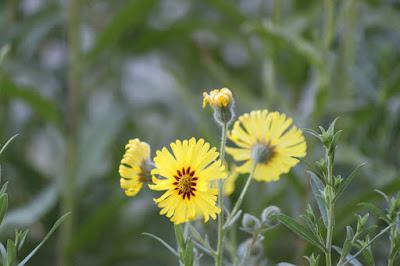
Heterotheca sessiliflora (admittedly, more spent blooms than fresh, but the fresh blooms do persistently keep appearing--they're out there even today, late September and 100 degrees):


Not a terrific picture here, I apologize, but I should mention Grindelia stricta var. platyphylla, which is a great-performing plant. Now, I had written a post a year or so ago about what a nemesis on the premises Grindelia turned out to be in my yard, but it is my belief that the monstrous, yard-taking-over plant was actually mislabeled at the nursery; luckily, I had already gotten a couple properly-labeled specimens from another nursery. I couldn't really go out there and say "Will the real G. stricta var. platyphylla please stand up," because the real plant stays quite low, whereas it was the impostor Grindelia that stood up and towered over everything. It's all gone now, but the real player remains, well-behaved and pleasingly late-flowering.


A little aside on Grindelia: another very lovely and well-behaved species is G. hirsutula, which is one of the first things to bloom for me in the spring.  Right now, the two I have are looking more than a little dormant, so I am worried that they may be actually, er, dead...time will tell. I hope they revive because they are an early-spring highlight.   But I digress. Back to the late summer blooms:


Our old friend Eschscholzia californica.  I don't know how or why, but it does come back for a fall encore, whether it gets any water or not:


Linanthus grandiflora. This guy, too, is an annual, but I'll be danged if it doesn't bloom all summer. I definitely need more of it next year.


These next two don't count as summer blooms, exactly, because the blooms have dried completely, but I leave them on and still think they are cool-looking.

Eriogonum umbullatum:


Gnaphalium californicum:


And finally, I seem to have failed to get photographic documentation of this, but the Sisyrinchiums, both bellum (blue-eyed) and californicum (yellow-eyed), actually bloomed nicely in a couple places right through summer. It was, however, dependent on water--in both instances, they were near birdbaths that I empty and refill regularly. Still, goes to show that they can be all-summer bloomers if coaxed. Probably true of quite a few plants that otherwise take a nap for the latter half of summer.

Sep 7, 2010

Coloring summer


Sorry I've been off line for a while. I was working on quite a lengthy post, which I was just deciding to divide into two parts, detailing the many plants that have flowered in the yard over this last month. But I'm afraid I made a silly and catastrophic error and deleted the whole thing. Yes. I can't quite see reconstructing it all, so I'm just going to re-paste in the pictures, along with names, which I am not going to spell-check, so this'll be a little test for me. Sorry about the lack of descriptive text. The gist of my post was going to be that, contrary to popular myth, a lot of California natives do bloom late in the summer, and if one were to mass these plants together (which I have not done as yet), then one could have quite a colorful, myth-busting yard.  Please let me know if you would like more info on any of the plants; I can certainly provide it, but not just at the moment, and I don't want to delay posting another day longer. Ahh, blogging.


Epilobium canum


Monardella macrantha 'Marian Sampson'


Satureja mimuloides


Achillea millefolium (really a spring bloomer but late in my yard for some reason)


Salvia 'Pozo Blue' hybrid


Aster chilensis (its name has changed but I haven't learned the new one yet)


Eriogonum fasciculatum


Eriogonum nudum


Eriogonum grande rubescens (very recent photo)


Eriogonum grande rubescens (a month ago)


Eriogonum grande rubescens planted with Monardella villosa


I guess I will do this in two posts.  There are plenty more. The next post will feature the more yellow and white end of the summer bloom spectrum.


Aug 11, 2010

Blooming Disappointment

In my last post I featured a flowering plant that I'm really pleased with this summer, Madia elegans (it's still blooming without signs of stopping), and now I'll mention a plant that seems to have given blooming a miss this year. Eriophyllum lanatum. Great plant, and I see it all over Mt. Diablo. I don't know why it's not into blooming in the yard this year...maybe it gets a bit too much shade, though I think it gets a good five or six hours of sun, so....

I bought just one in March 2009 and was told by the nurseryman to baby it a little over its first year, and then it would spread far and wide but stay low. Check, check and check, and last year, though it was still small, it was covered in lovely yellow daisy flowers. I decided to make cuttings (it's one of the easiest plants to root that I've every tried) so now I have several of them, but not one bloomed.  Pity, because I was counting on ol' E. lanatum to provide some good-sized areas of bright summer color. It still makes a serviceable ground cover, and indeed, even a neighbor who isn't really into natives inquired about it, saying he liked the texture. So oh well. Maybe it'll bloom next year. 


Here it is in the foreground, last summer--it looks similar now but at least twice the size:


And  here's one of the cuttings:


And here are last year's flowers.  Sigh.

Jul 21, 2010

Summer Flower Superstar


Since there were some comments in my last post about the inevitable summer senescence of the native garden, I wanted to highlight a summer flowerer that I'm newly delighted with. Madia elegans. I'd read that it was a good for summer flowering, so bought three in 4" pots last fall. Then off to Yosemite I went for a little birthday treat, and when I came back I discovered I'd misjudged how much water the little pots would need while I was gone. Two of the three were toast, but I planted the survivor, and though it looked pretty sad, it hung on through the winter. Then I totally forgot about it!  Its foliage was pretty inconspicuous as the annuals started growing around it. Then right about when the last of the Clarkias were finishing up and I was feeling a bit sad to see the color go, I spotted a bud on a very tall stalk in among the Clarkias. It actually took me a minute to remember, Oh yeeaaah, that's that Madia that's supposed to bring summer color. Within a few days it was. That was a few weeks ago, and it's still going strong.  In the mid-day, the sun hits it full-on, and the flowers completely close up. Then when the evening shade moves over the plant, back out the sunny flowers come. On a sunny but not-too-hot day, the petals sort of semi-curl and look like they're getting ready to keel, but then they freshen right up again in the evening.

The plant is quite delightful, about 4.5 feet tall, narrow and sturdy.  It is is common throughout most of the state, and couldn't be easier once you get it in the ground. I hadn't watered  at all this year till I just ran the drip for a little while this weekend, and I think this plant would be fine whether I had done that or not. I plan to get several more this fall (and not kill them) and intersperse them here and there.

Jul 19, 2010

The Clarkia Clearcut


This weekend I finally cleared out the crusty remains of annual wildflowers that make the yard so showy in the spring, occasionally causing people on their daily constitutionals to stop and point and say nice things. (Full credit goes to the flowers themselves--it's not like I can take credit for letting a few annuals go to seed.) But that breathtaking season is long over, and I worry that people who aren't familiar with the concepts of California native gardening might think the yard is just a case of another homeowner who plants a spring garden, has enormous success for a little while, only to slack off and let it fail miserably. I actually have been that person in the past. These days though, it's a case of the plants doing exactly what they are supposed to do.

This is the second summer of the post-Ivy War era, and the second time I have, let's face it, let the annuals run amok. It does make for a spectacular spring, but they end up choking other things.  I refer to the corner yard as the Clarkia Forest in the spring though it is dotted with other flowers. But during the Clarkias' heyday, I spotted a poor Allium unifolium, which had gamely reproduced itself over its first year, but it was weak and pathetic, due to smothering by annuals. I also found a Monardella villosa, which is a great plant to have, what with its compact size and relatively late flowering schedule, but it too was nearly dead because of shading by annuals. So this coming fall, I really must steal myself to cull the volunteers. I've never had the heart to before, but sparing too many annual seedlings equals sacrificing other plants.  I had planned to simply spare myself the onslaught of fall seedlings by cutting down the stalks before most of the seeds dispersed--but time gets away from a person. The seed capsules were definitely in full dispersal mode.


Here's a pictorial progression of the Clarkia Forest.

While I am loathe to show my dorky self here, this picture surreptitiously taken by my Sweetie, does show a sort of carpet of small Clarkias in front of me, just in front of my handful of weeks. This is in mid-March.


Note the taller plant on the leftmost part of the above photo, which is white sage. Below is the same spot in the yard photographed a bit over two months later. The white sage is again on the left of the photo, but all you can see of it is its white-flowered stalks; as you can see, the wildflowers grew right up too.


This is the stage where passersby stop and ask the names of various flowers.

And then this weekend, well overdue for a tidying-up. Fortunately I have very mellow, tolerant neighbors.


And finally, a shot after the clearing. I spread a little bark, which I normally don't, because I always read that one mustn't ever let the crowns of natives be covered, and I fear the bark will slump downslope and encroach on said crowns, but I couldn't resist, because it creates a more cared-for look. It also covers up the drip irrigation tubing, which became alarmingly visible after the dead-plant removal.  I'm pretty happy with the "after" look--it seems reasonably classic California.


There is some color yet to come.  There is a lot of Solidago californica (goldenrod) in there, only one stalk of which is starting to bud.


I do have a bit of trouble with this plant being leggy and floppy, unfortunately. But also, various buckwheats are blooming strong, and the pearly everlasting (Gnaphalium californicum) will keep its dry whitish flowers on for a long time. The fuchsias (Epilobium) will be in full bloom later--not highlighted in this photo shoot, but I have a couple tucked here and there, old standbys that they are.  Aster will bloom later too. So, the color continues in some measure, but even if it didn't, I'm fine with just letting the yard rest. Summer is about relaxing, after all.

Jul 12, 2010

Four Seasons in One Hike


When I lived in San Francisco I used to love going running with the Crowded House song "Four Seasons in One Day" on my iPod (which of course hadn't been invented yet and was really a crude little device we called a "walkman"), because no matter where in the city I chose to run, I would seem to travel through at least four seasons. It struck me hiking near my current East Bay home this weekend that the situation was similar, even though the temperature and relative humidity stayed pretty constant. Looking around though, I could indeed see samples of each of the four seasons, at least as we identify them in California.

The weather has been unseasonably cool this summer, even cool enough that my non-heat-loving Sweetie has been agreeing to hike with me--so I'm going to cheat a little and call this the hike's representative of winter. Also, cresting a large hill, a westward vista revealed a blanket of fog stretching itself along the coast toward Mount Tam and I knew all too well what it felt like for the people under it. There is a famous saying, often (but I've heard erroneously) attributed to Mark Twain: "The worst winter I ever spent was a summer in San Francisco."  So I count that fog sighting as winter and summer both.

Then right underfoot I came across one, then another, impressive and stunning patch of Clarkias. I think it must be Clarkia affinis. The first is in semi-woodland, mixed with monkey flower, and the second is on completely exposed and sun-baked grassland. Its bloom time seems similar to Clarkia amoena, or Farewell to Spring, so it's natural to find it here in early summer. But as you can see by some of the photographed yet-to-unfurl buds, it's stretching its bloom time well, well into summer. I find it such a marvel that it manages to bring itself into existence among the nearly impenetrable mat of weedy grasses--all now crispy and dry as straw, another unmistakable emblem of the California summer.

I love the way the Clarkia petals catch the sunlight, like little chalices, and look so frail and dainty, even as one glance around the parched surroundings  proves that they are in fact tough as nails.


For comparison, here is Clarkia amoena in my yard a couple months ago. I think the garden conditions might cause it to be a bit exuberant, and also the nurseries might tinker around with the gene pool a bit. Honestly? I like the rugged, no-frills little Clarkia in nature better.


Another cheerful and willing bloomer on the dry and sun-drenched path is my old friend Grindelia stricta. Last summer I grew this guy in my yard, but wrote that I had to evict it because it just got too crazy. I had gumplants upwards of six feet in height; here in its natural home (a mere 2 miles away) it stays about knee-high, It's a cheery treat near the top of this hike's biggest climb, and it manages to bloom in spring and then way into summer. When I run this trail in the hot months, it's like a reward for making it to the top.


Next spring-summer spanning plant is Gnaphalium californicum. I am newly a huge fan. I have it in my yard for the first time this spring and have adored how it looks like little white lights among everything else. Up in the hills it grows in great patches and is at its most glistening and impressive now. In a few weeks, it will dry out but will remain quite lovely for a long time--hence its common moniker, Pearly Everlasting. On this hike, I see it in both stages.

Fresh spring look:


Mid-summer look:


Another spring flowerer I see soldiering on everywhere I look is good old monkey flower, Mimulus aurantiacus. In somewhat shaded areas on my hike, this plant looks as fresh as it must have in April. In my yard, it's pretty well gone into dormancy. I don't really know why all these plants I'm mentioning last longer in their natural homes than they do in my yard. Not like anyone's watering them out on the trail.


The fourth season, which I haven't got to yet, fall, is quite visible on much of the monkey flower, however. I find it so stunning to see the leaves turning scarlet, even as the yellow flowers are still fresh and bright.
 

What a lovely fall palette. And not too early, for us Californians. I find it pretty typical of the poison oak to be donning its scarlet wardrobe right about this time.


Another dazzlingly red denizen of this particular woodland is the spiny Ribes--it's not the speciosa that so many people put in their yards; I think it may be Ribes californicum or menziesii. At any rate, it's getting dressed for fall.  The monkey flower, poison oak and Ribes know what some of us don't want to admit yet: fall is right around the corner.


Hike location: http://www.ebparks.org/parks/sobrante_ridge