Though I am mostly at home with California-style seasons, the one thing I do find a bit tricky is the fact that the time of year when the yard requires most work (i.e. planting time) happens to coincide with the shortest days. I typically experience something close to agony when the sun sets on weekends, especially Sundays, because inevitably I’m nowhere near finished whatever I’m doing. I’ve maimed innocent plants by stomping around well past the time where I could actually see them. This weekend was different only in that I could thankfully note that it won’t get any worse.
I mention this because there seems to be a semi-common misconception that this happy milestone falls on or around December 21. But don’t delay celebrating: the evenings are getting longer already! The solstice is the shortest day, but the earliest sunset is before, about two weeks at our latitude, and the latest sunset about two weeks after. I was raised with a pack of science-minded siblings and never allowed to harbor misconceptions regarding celestial goings-on—not that I necessarily absorbed the mechanisms, in this case no doubt some perturbation in the planet’s rotation and/or orbit—and we always marked December 7 as the dusk-sodden day after which evenings would brighten. That was in Montana, and way down here in the Bay Area, it would be a day or two different. I couldn’t seem to find to-the-second data online, but it doesn’t get earlier/grimmer than this weekend. From here on out, our yard work time increases! Unless you’re the type who’s out there at the crack of dawn—I am, um, not.
That said, I don’t think there’s a whole lot left to do! Every plant that was ready for the ground is in it, bulbs are in, a few drainage issues are managed to the extent that they will be this year...The only thing I ran out of time for this weekend was seeds. Pity, because there is a string of lovely rainstorms in the 15-day forecast, and I hope, hope, hope there won’t be any major rain stoppages for the rest of the season. That would mean that once the seeds go in, I can in theory do things other than yard work on weekends. Not that there’s anything I’d rather be doing, but there are other things in need of doing. (I wonder if I can remember how to clean the house—where do I keep the vacuum? Do I have one?) I find it alarming that the yard does take so much time, but this is only fall #2 since the Ivy War. I couldn’t do everything the first year (in addition to the Ivy War, there was also Operation Lawn Begone and two neglecte d slopes in need of reclaiming), but this year should pretty much get me to where, going forward, I’ll just be doing maintenance and refinements. Some time soon I will sprinkle seeds of annuals in strategic locations, including patio pots (things like baby blue eyes and tidy tips are amazing in pots—I had better pictures, but they were lost in a computer melt-down), but I had also wanted to sow flats of all kinds of perennial seeds I collected last year. I don’t know, though. If I sow them, I will have to babysit them, pot them up…Possibly that is not the kind of thing gardeners with day jobs should attempt, regardless of sunset time. Unless gardening is their day job. I wish. Well, I’ll see. When I get out my little box o’ seeds to scatter the annuals, the lure of the other seed packets may be too much to resist.
One-year anniversary of the end to major ivy fighting marked by ceremony, controversy
 The sun rose bright and warm but the mood was somber as the yard’s native plants, nonnative trees and human resident gathered to mark the first anniversary of VS Day (Victory in the South), the last day of major fighting in the Ivy War. Veterans and residents recalled the gruesome battle of the Sunday After Thanksgiving, 2008, which raged from morning well into the night. Attendees recalled that resistance forces had been advancing along the southern front, battling entrenched ivy roots for weeks, and the four-day weekend associated with Thanksgiving had been set as a the target for victory.
The final battle was especially brutal, due to the refusal of General Spod (Swinging Pick of Doom) to budge on the end-of-weekend deadline. At the time, the general famously pointed out that war strategists had originally set November 1 as the deadline, and that this had already been missed by weeks, thus wasting several good rainfalls that would have benefitted new native plants, had they been able to move in on ivy-vacated ground. “We missed November 1, but we’re sure a hell not going to be out here in the trenches come December 1,” Spod told embedded reporters at the time. “To any critics out there, I would just say that if you spent one day out here on the ivy battlefield, you’d understand why we don’t plan to come out here again next weekend. The war ends here. Today.” As that Sunday battle raged, troops kept a nervous eye on the sun, undeterred in its westward movement toward its 4:51 setting, one of earliest of the year. Once the sun disappeared, the troops made the controversial decision to set up a work light, arousing neighbors’ concern for the human resident’s mental state.
Critics of the way the final battle unfolded have pointed out that substantial risks were taken with the wellbeing of both the large juniper trees, who suffered repeated pick blows to their root systems, and of the human resident, who suffered wrist and elbow tendonitis and lower back pain. At the anniversary ceremony, the human resident gave the following account of the battle: “My wrists and elbows were killing, man. My back was so sore I couldn’t stand up straight from noon on. I only got two bathroom breaks and no lunch!” But Spod could not launch attacks without the human resident’s aid and insisted on not backing down. “After the sun went down, I expected to be able to go back to the fort,” said the human resident. “But no, next thing I know the *%$# work light is out of the shed and set up on the sidewalk. The cord was draped over the fence and everyone was afraid Spod was going to slice it and get me electrocuted. It was *%#$ hectic, man. Plus the light was really directional, so everywhere you looked there were shadows, and it was *%$# impossible to tell the *%$# juniper roots from the *%$# ivy roots. I didn’t think anyone was gonna get out of there alive.”
 The juniper trees, also attending the memorial, added, “We lost probably a dozen or more good roots, just because there was ivy wrapped around them. The ivy tried to hide that way and we were the collateral damage. A certified arborist had been called in at some point during the war and advised General Spod not to sever any of our roots that were over 2 inches in diameter, but some got cut alright—maybe not severed, but cut up pretty good.”
Embeds witnessing the southern front battlefields did at the time report heavy juniper root damage, filing grisly accounts of the shocking red root interiors exposed and mixing with the ivy’s tan roots in a tangle of rhizomatous carnage that littered the yard and sidewalk.
The battle finally ended that Sunday at 10pm, and the front was declared liberated. Troops were too fatigued and demoralized to raise a “mission accomplished” banner and unceremoniously returned to their forts. The human resident recalled the battle aftermath: “I was so tired, I thought I might puke, but I didn’t. I probably wouldn’t have made it if it weren’t for the other human resident, my sweetie, greeting my return with a massive plate of pasta and a DVD of Robot Chicken Star Wars sketches. Man, that *%$# saved me, man.”
 President A. Manzanita addressed the crowd at the memorial, urging assembled plants to reflect on their freedom to spread and grow roots, free of ivy repression, and to give thanks for their cushy garden conditions. “Let us remember the resistance fighters who cleared the yard, and look to a future where all the yard’s plants—newly established natives and surviving exotics alike—join roots and thrive and in harmony under the banner of equality.” Manzanita added, “The ivy war was fought so that we native plants may enjoy luxuries that wild plants don’t. In our great yard, Yarrow and Salvia bloom into fall, and Needlegrasses stay green all summer.”
Later, in answer to charges that peacekeeping troop levels are at a season high, Corner Yard Chief of Staff Trichostema lanatum replied, “While it’s true that peacekeeping missions uproot ivy insurgencies every week, we must remember that not a single perennial or shrub has been lost to ivy attacks. Though we mourned a handful of annual wildflower casualties last spring, let’s remember that we lost more annuals to the one Gopher Incident than to all ivy explosions combined.” Lanatum also acknowledged that several Allium and Triteleia families had been rousted by anti-ivy forces, but added that all were successfully relocated, being dormant at the time.
Protests briefly interrupted VS Day ceremonies, with angry plants charging that the Grindelia stricta community had been unfairly exiled. President Manzanita replied that the Grindelias’ ouster was in the best interest of the yard’s security. “Let’s face it, the Grindelia were attempting a coup. We basically had a ‘meet the new boss, same as the old boss’ situation on our hands. The Grindelia was the next ivy.”
Many children of the Grindelia, who now number in the hundreds, called the charge a gross exaggeration and vowed to keep drawing attention to their cause. A nearby Saliva, who refused to give her hybrid name, seemed to sympathize. “Hey, I had my limbs cut way back by the hand clipper unit, and for what—because me and the Grindelias were hanging out over the sidewalk? I’m lucky to still be here.”
Still, most of the ceremony attendees, many accompanied by seedlings, projected a solemn, yet joyous attitude one year after the ivy liberation. A non-native Azalea, a long-time denizen of the yard, remarked on the post-ivy standard of living. “I’m doing better than ever,” she said. “I don’t know why. Maybe I get more water without ivy roots sucking it up. Or maybe it’s just an attitude thing—anyway, I now bloom from the beginning of November right into May, and I never used to do that.”
 Local bird populations seemed to concur. Said an American Robin, “I never used to stop in this yard. With so little space to forage on, it just wasn’t worth it. Now there are worms and bugs to go around.” A nearby Lesser Goldfinch agreed. “Now that there’s no ivy, the ladder can be set up under just about any tree and it seems like there’s a bird feeder everywhere you look. Not to mention fresh Yarrow, Buckwheat and other seeds. It’s like a whole buffet. Me and my buddies practically live here.”
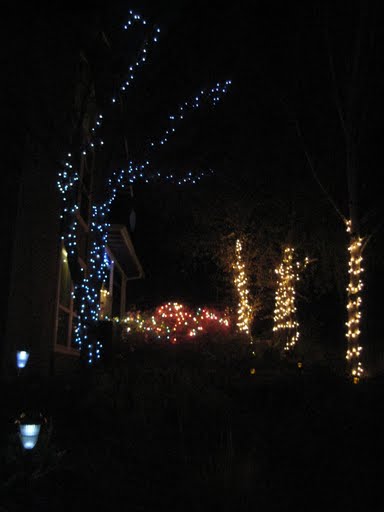
The day’s memorial ended with a Christmas-light vigil, intended to commemorate both VS Day and the anniversary this week of the Christmas Light Uprising that started the war.

 I’m no longer so optimistic about the prospects of a wet winter, but nevertheless, the weekend-after-Thanksgiving plan is to get a heap more bulbs in the ground. I probably go a little crazy on bulbs. How can you not? Last year I put in 250, distributed around the yard. I got them in fairly late—Christmastime—owing to delays associated with the protracted Ivy War. And bulbs were last in the planting queue, so that I wouldn’t have to worry about inadvertently digging them up while planting other things. Despite their somewhat late planting, they did not disappoint—March brought pretty pink powder puffs of Allium unifolium, and by April the whole yard was dotted with the ultramarine of Triteleia laxa (Ithuriel’s Spear), with a dash of variously-colored, swoon-inducing Calochortus (superbus and venustus) sprinkled in. For reasons I don’t understand, and someone with more botanical knowledge can maybe fill me in, the Calochortus produced several blooms per bulb, whereas the Allium and Triteleia produced one inflorescence per bulb. This year though, I’m hoping for a real treat, because I know these bulbs have been busy multiplying. I occasionally accidentally dig them up while pursuing ivy insurgents, and have been thrilled to find three to six bulbs, depending on conditions, wherever I’d planted one. This in just one year!
And this season I’m adding red and yellow to the bulb mix. The guidelines I follow on designing with color are as follows: more is more, and colors can’t clash. (I especially adhere to these rules in the context of gardens, but come to think of it, I pretty much apply them in most contexts—like Fiesta dishes for example, but don’t even get me started.) The red will be coming from one Dichelostemma ida-maia, and the yellow from Triteleia ixioides. I don’t have a planting plan, per se, just gonna go out with a box of bulbs in one hand and a trowel in the other and start planting. If spring brings yellow, pink and red side by side, that’s more than fine with me. For more info on these beauties, see the descriptions I wrote for Garden Natives here.
I am a bit worried about the rain situation; the four inches my rain gauge collected in October, which I’d then celebrated as a wondrous miracle, are a distant memory now, but it did induce last year's bulbs to start growing—not to mention starting a veritable carpet of wildflower seedlings. Someone knowledgeable told me not to worry, that the bulbs could sort of “push pause” and then resume growing when rain returns, but I haven’t quite been confident enough with that advice to refrain from watering. Therefore, I’ve been setting a sprinkler throughout the yard—I hate to, but I’m just too scared of letting the bulbs croak. As it is, I’m nervous I haven’t sprinkled enough. It’s a lot of dang hassle moving the hose around the yard at intervals—it takes like a day. As for the annual seedlings, a few patches in harder-to-haul-the-hose-to areas did bite the dust, but it’s not too tragic, because I have tons of collected seed squirreled away in envelopes, so I’ll simply throw out a second wave of annuals later when the rain seems more reliable.
In the event that the El Nino predictions are off and the rains never get very reliable…well, I’ll keep watering. People make fun of me because I’m dragging a hose around after touting my drought tolerant native garden, but come on people, I didn’t mean this time of year! I was puzzling over this subject with a dude at my work, who is a harsh critic of my decision to water, and we were saying, Well what happens during dry years in nature? My conclusion was, Nature doesn’t care if she loses a bunch of bulbs or anything else once in a while, because she has all the time in the world. But the gardener is attached to the plants she lovingly placed (not to mention purchased), ergo the gardener hauls out the hose during dry spells. I hope to not need to much longer.

Dang, so much for my super-soaker winter prediction! Just kidding, I know there’s still plenty of time—as pointed out by the weather blog I’m anxiously following these days. Plus we are still way, way over normal rainfall to date, which is a great and magical thing. It’s just that I was hoping the ground wouldn’t have a chance to dry back out, because as part of my Yard 2.0 plan, I am still putting in a lot of new plants. (Last year’s Yard 1.0 left plenty of room for both additions and do-overs.) I wanted to get all plants in as early as possible so they could spend lots of time establishing and therefore need very, very little water next summer, and I have about half in now, but looks like I will need to babysit them until the rains come back to stay. I have a great drip system that was installed by the eminently knowledgeable Garden Natives during the summer, so that will be a boon, but some of the new plants are out of its reach. Also, after the October rain, the entire yard became a carpet of wildflower seedlings, and even though I will need to cull a huge number (*sniff!*), I can’t bear to let the rest keel over from thirst, which means I’ll probably set out the old fashioned sprinkler a few times. I know sprinklers use an outrageous amount of water, which makes me really wish I had planned and installed a rain water catchment system. I had abandoned the idea on the grounds that it was too much hassle and money, but now I realize if I’d done it, I’d have hundreds of gallons of free water just waiting to go out on those new plants. Also, I accidentally left my wheelbarrow and a Rubbermaid bin out in the October storm, and it felt so eco-friendly pouring it on my plants, I got sort of hooked. Plus, as every gardener knows, rain water is infinitely more beneficial than tap water. I’m told by a Very Smart Dude I know (my brother), that this is because rain picks up nitrogen from the atmosphere. So I’ll be shopping rain barrels soon, and will post whatever I come up with here.
This afternoon’s rainstorm made me even more inclined to go out on a limb and believe in the prospect of a nice, soaking El Nino year. I keep reminding myself that we had early rain last year (Halloween), only to be followed by a disappointing November and December, a disastrously crispy January, and sub-normal annual totals. But this year, how can one not feel we’re in for a drenching? I’ve been keeping my eyes out for actual data to post here pertaining to the likelihood of a strong El Nino, but I’ve come across little. This guy, whose blog I’m going to start following, thinks we’ll have a wetter than average winter, but doesn’t make any terribly bold proclamations. (The wettest weather will be from late December to early March—well, yeah.) He breaks the west into southwest and northwest, and I didn’t know which the Bay Area is, so I dropped him a line—we’re southwest. The latest press release from NOAA makes a lot of predictions, the most undramatic and conservative of which is for California. Other than these, I’ve read a few stories saying we’ll definitely have a weak El Nino, and maybe will or maybe won’t have a moderate one. Then I came across this story reporting that a lot of data doesn’t exist, due to damaged or lost weather buoys—subscription required, but the gist is, data-gathering buoys have been damaged and/or stolen, so current long-range forecasts are spotty).
So all bets are off! But I’m betting on a soaker anyway, and getting my new plants in the ground early. People seem to dismiss the freakish rain we had in September by saying it was the remnants of a hurricane off Baja, and the brilliant deluge last week (about 4 inches by my rain gauge) is explained as the remainder of some typhoon off Japan. But citing the origins of those rains doesn’t explain them, it just begs the question—we don’t usually have rainy remnants of hurricanes and typhoons in fall, so why are we now?
For the short term, I'm starting to take dry short-range forecasts with a dose of optimistic skepticism—today the forecast was “showers.” I was out on an errand for work when the showers hit; umbrella-less and desperate, I took refuge on a passing bus, not caring where it was going. It happened to cross Market at Powell, so I bailed off and ran as fast as I could down the stairs to the Muni/Bart station, but the stairs had become a waterfall, with a pond at the bottom that was ankle-deep. I couldn’t help being reminded of the 1997-98 El Nino. At that time in my life, I despised rain, our apartment in the lower Haight ‘hood not affording a lot of gardening opportunities to help me appreciate its necessity. We clocked about three times normal that year and I thought of that year as a year to endure; now I would love to endure another. Even on the rare sunny days, the city’s supersaturated parks seeped constant streams onto the sidewalks and down the streets. It was as though all the open spaces were Glenn Beck, unable to stop weeping, and seemingly for no reason. One clear, warm day I went running and stepped in dog poo, so I simply detoured over to Buena Vista Park and held my shoe under the powerful, cleansing faucet that was its northeast stairs. That’s the kind of year I’m hoping for now, partly because the state just needs it, and partly because it will establish the hell out of my plants—the 12 flats I’m putting in this fall, and everything I planted last year. That “once established” caveat you always see on plant descriptions following the words “drought tolerant” is going to be taken care of in short order.
I keep also toying with the idea of collecting roof runoff. I saw some barrels at Home Despot that looked pretty simple to hook up, and for a while I was determined to ask for them for my birthday; but when the time came I’d sort of rethought it, because it seemed so complicated—the barrels would fill quite quickly, and then where would I store the water? If I could get a bunch of storage barrels, how could I transfer the water into them if they weren’t downhill from the collection sites—and how would I apply the water to plants if they in turn weren’t downhill from the storage barrels? I’m sure these questions have answers, it just seemed too tiring and potentially expensive to figure them out. But when a coworker asked me if I had my rain barrels out last week and I admitted I’d sort of abandoned the idea, he seemed so crestfallen it caused me to start thinking about it again. I had rationalized that my downspouts all empty into the soil anyway, rather than into some street drainage pipe, but my astute coworker pointed out that the ground can only hold so much—witness the weeping parks of ’97-98. And USDA Soil Survey tells me the water on my plot has only 80 inches to sink in before hitting impermeable rock, after which I think it joins the great rushing river in a pipe under the street and out to the bay. So there is then something to this rain collection idea. If anyone knows how to do it and can recommend a source for supplies, please post here!!
It wasn't my intention to start a blog and never post updates, but owing to a combination of being busy at work, a little work travel, a little fun travel, classes, and getting ready for fall planting, blogging time is minimal. (Oh, and throw in my sloth-like energy level.) I knew this would happen, yet still hope to keep up more at some point. For now I'm just going to throw some pictures of birds on here--and replace the "What's Blooming" list with my Yardbirds List (no, Jimmy Page isn't on it), which I hope I will be able to update with more bird sightings in the future. I'm only going into Year 2 of full-on native gardening, so I have high hopes that the number of bird friends visiting in the yard will only go up.
My sweetie gave me an amazing Birdcam that can be hung or mounted on a tripod, and set to take a photo when it senses motion. Last week we put it in the most active bird zone, the back patio birdbath. One of the most tragic things about having to work is that I miss the Morning Bath Parade five out of seven days, but at least this way I can get a photographic recap!
The next round of pics should include some sparrows, who arrived this week. I've granted them clemency, even though last year they devoured my Stylomecon heterophylla (wind poppy), as well as the Nemophila menziesii (baby blue eyes) I had in patio pots. (The Nemophila came roaring back, the Stylomecon did not.) I notice they still like to nibble on the leaves of many plants I currently have out there, but I rejoice at the sparrows' return and their confirmation that fall is really here. Fall was in the light and on the buckeye branches well before it was in the air, but now the weather is finally cool, the sparrows are back in town, the nice people at Accuweather promise a night of irrigation from the sky on Monday, and I have a dozen flats of plants ready to go and 25 species of bird friends. Life is good.


There's no shortage of stories in the news to write letters to editors about, and I almost never bother, but we all have our buttons, I guess. Mine are word misusage and invasive plants. I wrote this letter to the Contra Costa Times ages ago and pretty much forgot about it, but then I spotted it while I was at the airport eating a gross overpriced tofu curry and flipping through the Sunday paper.
Can also be seen here. http://www.contracostatimes.com/letters/ci_13414116


 d slopes in need of reclaiming), but this year should pretty much get me to where, going forward, I’ll just be doing maintenance and refinements. Some time soon I will sprinkle seeds of annuals in strategic locations, including patio pots (things like baby blue eyes and tidy tips are amazing in pots—I had better pictures, but they were lost in a computer melt-down), but I had also wanted to sow flats of all kinds of perennial seeds I collected last year. I don’t know, though. If I sow them, I will have to babysit them, pot them up…Possibly that is not the kind of thing gardeners with day jobs should attempt, regardless of sunset time. Unless gardening is their day job. I wish. Well, I’ll see. When I get out my little box o’ seeds to scatter the annuals, the lure of the other seed packets may be too much to resist.